Specific energy and flow regimes
- 1 Specific energy
- 2 Physical interpretation
- 3 From Bernoulli to specific energy
- 4 Specific energy equation
- 5 Rectangular channel with $\alpha=1$
- 6 Specific energy diagram
- 7 Flow classification
- 8 Alternate depths
- 9 Applications
- 10 Numerical problem: locating points on the specific energy diagram
- 11 Solution outline: locating points on the diagram
- 12 From specific energy to hydraulic jump
- 13 Hydraulic jump linkage
- 14 Why specific energy is still useful for hydraulic jumps
- 15 Quick comparison: alternate depth vs sequent depth
- 16 Check question
1 Specific energy
Definition
- Energy per unit weight relative to channel bottom
- Sum of depth and velocity head
- More formally, the height of the energy grade line above the channel bottom
2 Physical interpretation
- Specific energy is measured from the channel bottom
- Elevation head $z$ is taken as zero
- Depth term $y$
- Comes from pressure head
- Equals water depth for hydrostatic conditions
- Interpretation
- Small $y$: velocity term dominates
- Large $y$: depth term dominates
- Important note
- $y$ is not elevation head
- It represents pressure head expressed as depth
3 From Bernoulli to specific energy
- Choose channel bottom as datum
- $z = 0$
- Interpretation
- Depth term comes from pressure head
4 Specific energy equation
\begin{equation} E=y+\frac{\alpha V^2}{2g} \label{eq:specific-energy} \end{equation} where
- $E$ is the specific energy,
- $y$ is the flow depth,
- $\alpha$ is the kinetic energy flux correction,
- $V$ is the mean cross-sectional velocity, and
- $g$ is the acceleration of gravity.
5 Rectangular channel with $\alpha=1$
For a rectangular channel with $\alpha=1$, Eq. (\ref{eq:specific-energy}) can be rewritten as \begin{equation} E=y+\frac{q^2}{2gy^2} \end{equation} where $q=Q/b$ and $b$ is the channel width.
5.1 Critical depth and specific energy
\begin{align} \frac{dE}{dy}&=1-\frac{q^2}{gy_c^3}=0\label{eq:dEdy}\\ y_c&=\left(\frac{q^2}{g}\right)^{1/3}\label{eq:yc} \end{align} \begin{equation} E_c=y_c+\frac{q^2}{2gy_c^2}=y_c+\frac{q^2}{gy_c^3}\frac{y_c}{2}=y_c+\frac{y_c}{2} =\frac{3}{2}y_c \label{eq:Ec} \end{equation} where $\dfrac{q^2}{gy_c^3}=1$ by Eq. (\ref{eq:dEdy}).
5.2 Froude number
From Eq. (\ref{eq:dEdy}), we can obtain \begin{equation} \frac{dE}{dy}=1-\left(\frac{q}{\sqrt{gy_c^3}}\right)^2=1-\mathbf{F}^2=0 \end{equation} where the Froude number $\mathbf{F}$ is defined as \begin{equation} \mathbf{F}=\frac{q}{\sqrt{gy^3}}=\frac{q/y}{\sqrt{gy}}=\frac{Q/(by)}{\sqrt{gy}}=\frac{Q/A}{\sqrt{gy}}=\frac{V}{\sqrt{gy}} \end{equation}
6 Specific energy diagram
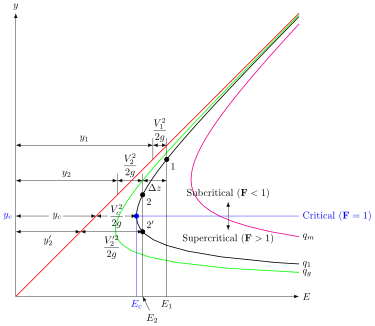
Key features
- Two depths for the same energy
- Upper branch: subcritical
- Lower branch: supercritical
- Minimum point
- Critical depth $y_c$
- Critical energy $E_c$
- Minimum energy to carry discharge
Which of $q_g$ or $q_m$ is greater or less than $q_1$? Can you explain why?
7 Flow classification
- $Fr < 1$
- Subcritical
- Deep slow flow
- $Fr = 1$
- Critical
- $Fr > 1$
- Supercritical
- Shallow fast flow
8 Alternate depths
- For $E > E_c$, two possible depths
- $y_1$ subcritical
- $y_2$ supercritical
- Same discharge and energy
- Different velocity and depth
- Transition requires energy loss
- Example: hydraulic jump
9 Applications
- Channel design
- Avoid unstable transitions
- Control structures
- Weirs and flumes enforce critical flow
- Hydraulic jumps
- Energy dissipation
- Flow measurement
- Critical depth relationships
10 Numerical problem: locating points on the specific energy diagram
Given
- Rectangular channel
- $Q = 12 \ \text{m}^3/\text{s}$
- $b = 3 \ \text{m}$
- $g = 9.81 \ \text{m/s}^2$
Tasks
- Compute the critical depth $y_c$
- Compute the critical energy $E_c$
- For $E = 2.50 \ \text{m}$, determine the two alternate depths
- Identify which point is:
- Critical
- Subcritical
- Supercritical
- Sketch these three points on the specific energy diagram
Key points
- Start with
- $E = y + \frac{Q^2}{2 g b^2 y^2}$
- Critical condition
- $y_c = \left(\frac{Q^2}{g b^2}\right)^{1/3}$
- For a given $E > E_c$
- One larger depth is subcritical
- One smaller depth is supercritical
11 Solution outline: locating points on the diagram
- Critical depth
- $y_c = \left(\frac{12^2}{9.81 \cdot 3^2}\right)^{1/3} = \left(\frac{144}{88.29}\right)^{1/3} \approx 1.18 \ \text{m}$
- Critical energy
- $E_c = \frac{3}{2} y_c \approx \frac{3}{2} (1.18) = 1.77 \ \text{m}$
- Since $E = 2.50 \ \text{m} > E_c$
- Two alternate depths exist
- Solve
- $2.50 = y + \frac{12^2}{2 \cdot 9.81 \cdot 3^2 y^2}$
- $2.50 = y + \frac{0.815}{y^2}$
- Results
- $y_1 \approx 2.35 \ \text{m}$ subcritical
- $y_2 \approx 0.69 \ \text{m}$ supercritical
- Location on the diagram
- $(E_c, y_c) = (1.77, 1.18)$ is the minimum point
- $(2.50, 2.35)$ lies on the upper branch
- $(2.50, 0.69)$ lies on the lower branch
12 From specific energy to hydraulic jump
Specific energy explains
- Why two alternate depths can exist for the same discharge
But a hydraulic jump is not analyzed with specific energy alone
- Because energy is lost in the jump
Instead
- Use momentum or specific force to relate sequent depths
Hydraulic jump interpretation
- Flow approaches as supercritical
- Abruptly transitions to subcritical
- Depth increases sharply
- Energy is dissipated
13 Hydraulic jump linkage
Before jump
- Shallow fast flow
- Supercritical
- Lower branch of specific energy curve
After jump
- Deep slow flow
- Subcritical
- Upper branch of specific energy curve
Across the jump
- Discharge is conserved
- Momentum is approximately conserved
- Specific energy decreases
Important distinction
- Alternate depths: same specific energy
- Sequent depths: same momentum, different specific energy
14 Why specific energy is still useful for hydraulic jumps
It helps explain the flow states
- Upstream state is supercritical
- Downstream state is subcritical
It shows that the downstream depth after a jump cannot be found by setting the same $E$
- Because $E_1 > E_2$
It helps visualize energy loss
- The post-jump point lies at lower energy than the pre-jump point
So
- Specific energy is for flow-state interpretation
- Momentum is for hydraulic jump calculation
15 Quick comparison: alternate depth vs sequent depth
- Alternate depths
- Same discharge
- Same specific energy
- One subcritical and one supercritical
- Read from the same specific energy curve
- Sequent depths
- Same discharge
- Same momentum function
- Connected by hydraulic jump
- Specific energy decreases across the jump
16 Check question
A supercritical flow enters a hydraulic jump
Which statement is correct?
- Specific energy is conserved across the jump
- Momentum is conserved but energy is lost
- Both momentum and energy are conserved
- Neither momentum nor discharge is conserved
Answer: 2. Momentum is conserved but energy is lost