Open channel hydraulics
- 1 What is open channel hydraulics?
- 2 So what is a free surface then?
- 3 Open channels
- 4 Applications of open channel hydraulics
- 5 Characteristics of open channel flow
- 6 Manning’s equation
- 7 In-class problem 1: Basic geometry
- 8 In-class problem 2: Velocity and discharge
- 9 In-class problem 3: Flow classification (Froude number)
- 10 In-class problem 4: Combined computation
- 11 In-class problem 5: Interpretation
- 12 Challenge problem
1 What is open channel hydraulics?
It’s the study of the physics of fluid flow that forms a free surface driven by gravity.
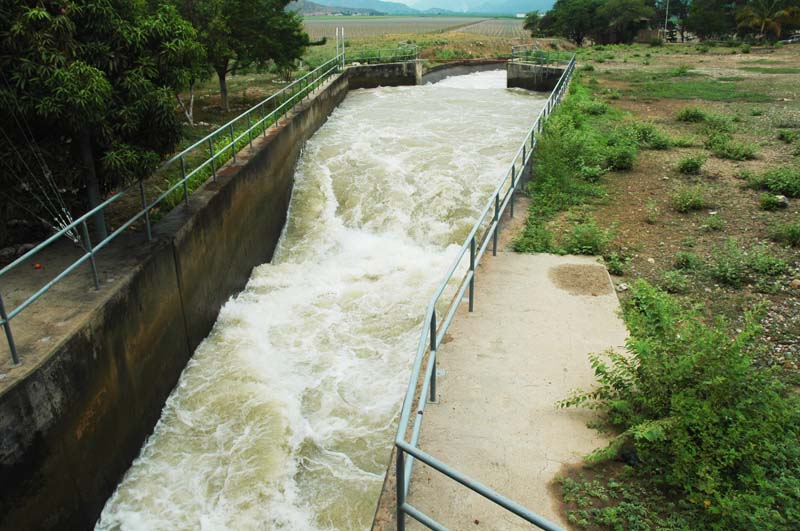
2 So what is a free surface then?
When flowing fluid interfaces with the ambient atmosphere, we call the surface of the flow a free surface.
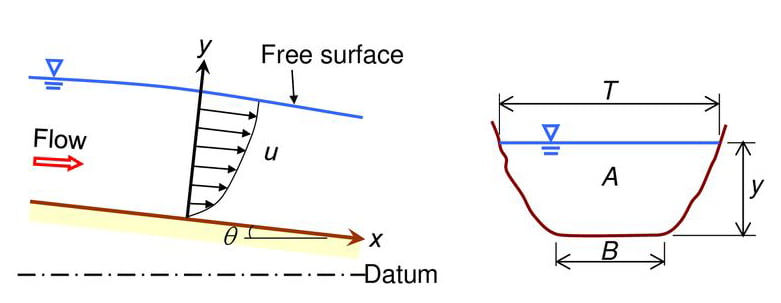
3 Open channels
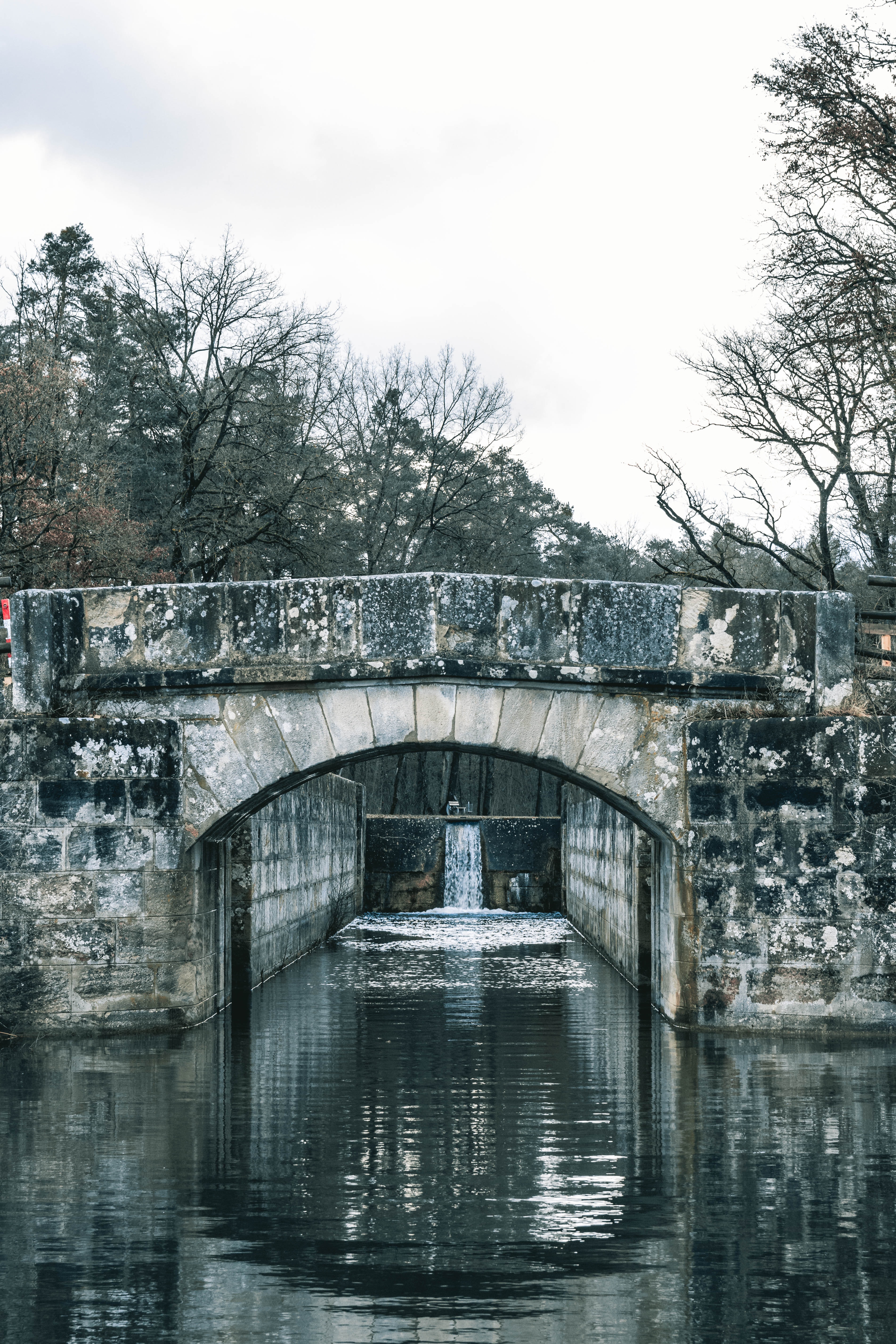
Open channels can be natural or man-made.

4 Applications of open channel hydraulics
4.1 Design of artificial channels
- Irrigation
- Drainage
- Water supply
- Wastewater conveyance
4.2 Analysis of flooding in natural waterways
- Delineate floodplains
- Assess flood damages for a flood of specified frequency
4.3 Descriptive and predictive applications
- Describe the transport and fate of environmental contaminants
- Predict flood surges caused by dam breaks or hurricanes
5 Characteristics of open channel flow
5.1 Flow boundaries
In closed conduit flow, its boundaries are fixed by the conduit geometry.
However, in open channel flow, the free surface along the streamline adds an extra degree of freedom and complicates the mechanics of open channel flow.
5.2 Driving forces
Closed conduit flow is driven by a pressure difference while open channel flow is driven by gravity.
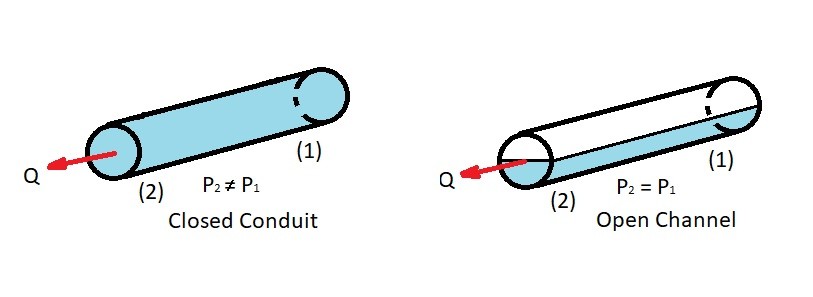
Yes! Partially full pipe flow is also driven by gravity and we cannot use the closed conduit equations.
5.3 Subcritical and supercritical flows
The flow regime in open channels is determined by the Froude number (the ratio of inertial to gravitational forces).
\begin{equation} F = \frac{V}{\sqrt{gD}} \end{equation}
where
- $V$ = mean velocity
- $D$ = hydraulic depth
- $g$ = gravitational acceleration
5.4 Flow regimes
- Subcritical flow: $F < 1$
- Deep, slow flow
- Disturbances can travel upstream and downstream
- Critical flow: $F = 1$
- Transition state
- Supercritical flow: $F > 1$
- Shallow, fast flow
- Disturbances can travel downstream only
5.5 Physical interpretation
- Subcritical: gravity effects dominate
- Supercritical: inertial effects dominate
5.6 Open channel flow solutions
- Theoretical
- Experimental
- Numerical
5.7 Types of open channel flow
Non-changing vs. changing:
- Steady vs. unsteady: Temporal variations
- Uniform vs. nonuniform: Spatial variations
Types of nonuniform flow:
- Gradually varied
- Rapidly varied
- Spatially varied
6 Manning’s equation
Manning’s equation is an empirical relation for uniform open channel flow.
\[ V = \frac{1}{n} R^{2/3} S^{1/2} \]
\[ Q = AV \]
where
- $V$ = mean velocity
- $Q$ = discharge
- $A$ = cross-sectional area
- $R = A/P$ = hydraulic radius
- $S$ = channel slope (energy slope in uniform flow)
- $n$ = Manning’s roughness coefficient
6.1 Key points
- Velocity increases with hydraulic radius and slope
- Rougher channels (larger $n$) reduce velocity
- Valid for uniform flow conditions
7 In-class problem 1: Basic geometry
Rectangular channel
- Width $b = 4\ \text{m}$
- Flow depth $y = 1.2\ \text{m}$
Find:
- Cross-sectional area $A$
- Wetted perimeter $P$
- Hydraulic radius $R = A/P$
8 In-class problem 2: Velocity and discharge
Rectangular channel
- $b = 3\ \text{m}$
- $y = 1.0\ \text{m}$
- Manning’s $n = 0.015$
- Bed slope $S = 0.001$
Find:
- Mean velocity $V$
- Discharge $Q$
9 In-class problem 3: Flow classification (Froude number)
A channel has
- Velocity $V = 2.5\ \text{m/s}$
- Hydraulic depth $D = 1.2\ \text{m}$
Find:
- Froude number $F$
- Classify the flow (subcritical, critical, or supercritical)
10 In-class problem 4: Combined computation
Rectangular channel
- $b = 5\ \text{m}$
- $y = 1.5\ \text{m}$
- $n = 0.018$
- $S = 0.0008$
Find:
- $A$, $P$, $R$
- Velocity $V$
- Discharge $Q$
- Froude number $F$
- Flow classification
11 In-class problem 5: Interpretation
Two channels carry the same discharge
- Channel 1: $F = 0.6$
- Channel 2: $F = 1.4$
Answer:
- Which flow is subcritical?
- Which flow is supercritical?
- In which channel can disturbances travel upstream?
12 Challenge problem
Trapezoidal channel
- Bottom width $b = 4\ \text{m}$
- Side slope $z = 2$
- Depth $y = 1.5\ \text{m}$
- $n = 0.020$
- $S = 0.0008$
Find:
- $A$, $P$, $R$
- Velocity $V$
- Discharge $Q$
- Froude number $F$